
I've read many times over that the benefits of student blogging come from the change of audience. When the audience shifts from teachers and classmates (and sometimes parents) to a more global audience (even if it is just a perception) students are intrinsically motivated to perform better. Many feel that this is simply because they do not want to be embarrassed of poor skills publicly. While this may be true in a small minority of students, I think they are motivated because they are contributing to the knowledge of a global society. They are hitting the highest level of Bloom's Taxonomy (creation) and want to be perceived as professionals.
While reflecting upon this during some planning for the student blogs I want to get up and running, I had an "a-ha" moment. If students are motivated by creating information on the Internet, logically teachers should be too. To put this theory to the test, I've decided to utilize a wiki with my teachers as a part of our PLC.
This year we've chosen to focus on engaging students as a part of our district's two-pronged plan (assessment and engagement) to increase high school completion over the next 5 years. We have done some work with John Antonetti, where he introduced us to his Learning Cube. The Learning Cube combines elements of Marzano's instructional strategies, Bloom's taxonomy and Schleckty's Working on the Work strategies for engaging students. Antonetti believes that if you incorporate one element from each side of the cube, students will be engaged. It is this theory we will put to the test.
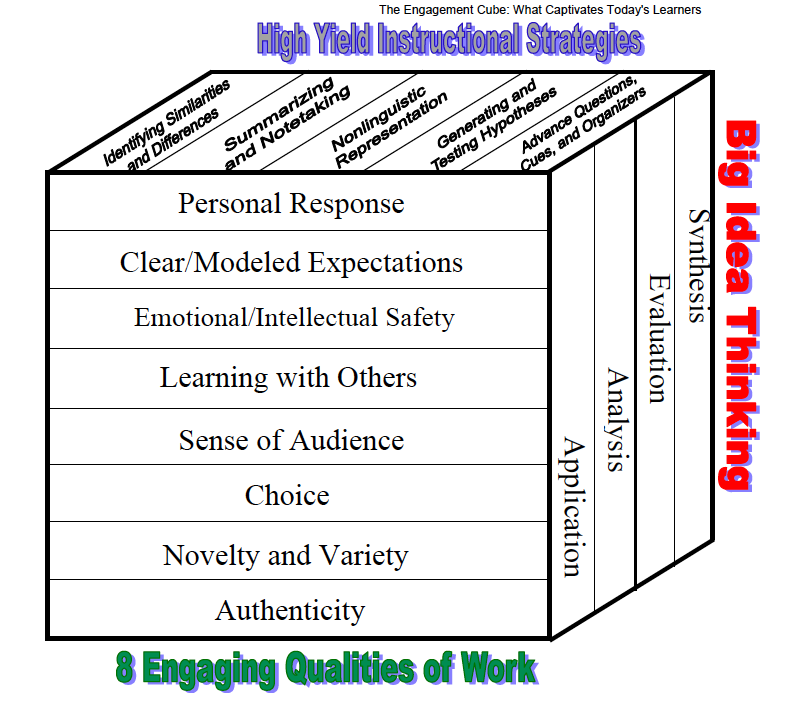
Through cycles of learning, experimenting and reflection, we plan on implementing lessons and activities designed with the cube to measure expected increases in the levels of student engagement in our classrooms. Because this is new to our district, I can think of no better way to help out other teachers who are experimenting with the cube and focusing on engagement than to collaboratively create a resource outlining our journey. Hence the wiki.
Follow our journey here.
Showing posts with label blogs. Show all posts
Monday, October 3, 2011
Wednesday, April 13, 2011
Blogging: Why Aren't You Doing It?
Last week on Twitter, someone had asked what Web 2.0 tools were the most beneficial to classrooms. For me, there was only one answer: Blogging. What is so great about blogging, you ask? There are numerous educational benefits to blogging, both for students and teachers. In fact, the very first blog post that I wrote was about classroom blogging.
Blogging is about literacy, something as teachers we strive to impart on our students. As teachers we should also be modelling literacy so students have an example of where they should be heading.
Taking this idea further, blogging can be a way for students to demonstrate their learning by creating a product. For example, if students are learning about Japanese culture, they could create a series of blog posts demonstrating what they've learned. Within these posts could be not only text, but weblinks, images, videos, and slideshows that the students have created or found. Once the posts are published, other students, teachers and parents could then leave comments or feedback for them. The online conversation, post-publication, is where learning occurs on a larger scale. Readers have the opportunity to analyze and synthesize the information from the post and consider the viewpoints of others.
As a teacher, blogging can be used as not only an instructional tool, but also as a reflective tool. Teachers could create blog posts with their thoughts and feelings towards an idea, for example the Libya situation, and ask students to respond with their feelings. They could use a blog as a way to reflect on their teaching practice with other colleagues, by seeking their input and feedback.
Here are a number of links with ideas for utilizing blogs in your classroom:
33 Ways to Use Blogs in an Educational Setting
10 Great Ways to Use Blogs in the Classroom
Blogs in Education
Ways to use Weblogs in Education
Blogging Rules
10 Ways to Motivate Students to Blog
As for which blogging service to use, there are a number of different providers that I would recommend. First, with students I would recommend starting with edublogs.org. You can sign up as a teacher and create student accounts underneath you. It has very easy settings to change who can view and comment on your blog, depending on your comfort levels. For teachers, I would recommend using either Blogger (which this blog is created on) or Wordpress. Both of these services are fairly easy to set up and maintain, however, I believe that Wordpress is more geared towards advanced users (don't quote me on that one though).
Here is a video created by students who are sharing the reasons that they like to use blogs as an educational tool.
Blogging is about literacy, something as teachers we strive to impart on our students. As teachers we should also be modelling literacy so students have an example of where they should be heading.
Taking this idea further, blogging can be a way for students to demonstrate their learning by creating a product. For example, if students are learning about Japanese culture, they could create a series of blog posts demonstrating what they've learned. Within these posts could be not only text, but weblinks, images, videos, and slideshows that the students have created or found. Once the posts are published, other students, teachers and parents could then leave comments or feedback for them. The online conversation, post-publication, is where learning occurs on a larger scale. Readers have the opportunity to analyze and synthesize the information from the post and consider the viewpoints of others.
As a teacher, blogging can be used as not only an instructional tool, but also as a reflective tool. Teachers could create blog posts with their thoughts and feelings towards an idea, for example the Libya situation, and ask students to respond with their feelings. They could use a blog as a way to reflect on their teaching practice with other colleagues, by seeking their input and feedback.
Here are a number of links with ideas for utilizing blogs in your classroom:
33 Ways to Use Blogs in an Educational Setting
10 Great Ways to Use Blogs in the Classroom
Blogs in Education
Ways to use Weblogs in Education
Blogging Rules
10 Ways to Motivate Students to Blog
As for which blogging service to use, there are a number of different providers that I would recommend. First, with students I would recommend starting with edublogs.org. You can sign up as a teacher and create student accounts underneath you. It has very easy settings to change who can view and comment on your blog, depending on your comfort levels. For teachers, I would recommend using either Blogger (which this blog is created on) or Wordpress. Both of these services are fairly easy to set up and maintain, however, I believe that Wordpress is more geared towards advanced users (don't quote me on that one though).
Here is a video created by students who are sharing the reasons that they like to use blogs as an educational tool.
Subscribe to:
Comments (Atom)

